Trade analysis and tips for trading the euro
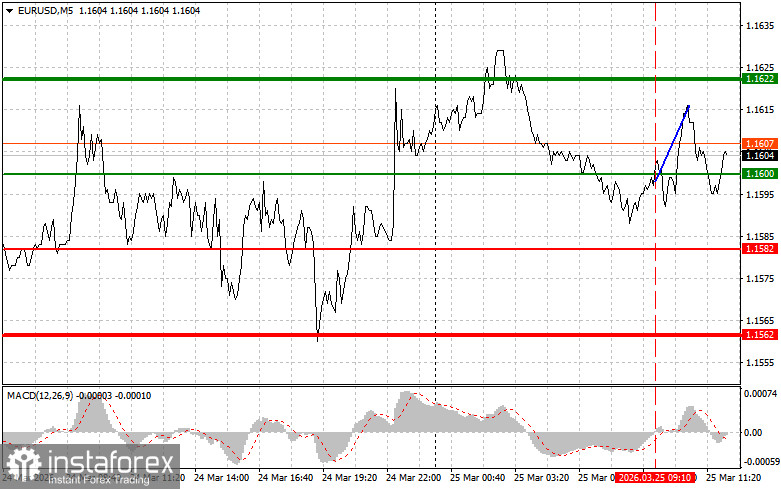
The test of the 1.1600 price level occurred when the MACD indicator had just started moving upward from the zero mark, which confirmed a correct entry point for buying the euro. As a result, the pair rose by 15 points.
Germany's IFO economic research institute data, which slightly exceeded economists' expectations, nevertheless failed to trigger significant growth in the euro. Although a slowdown in business activity had been widely anticipated—especially in light of recent events—the business climate index showed surprising stability, indicating a moderate level of optimism among German businesses. At the same time, the absence of a clear recovery or rapid growth prevented a noticeable increase in volatility, allowing trading to proceed in a relatively calm manner.
It is expected that little will change in the second half of the day. Data on the U.S. current account balance and the import price index are due. The current account balance reflects a country's external economic relations, covering the movement of goods, but is unlikely to significantly affect the U.S. dollar in the short term. The import price index, in turn, serves as an indicator of inflationary pressure related to imported goods and services. Its dynamics can provide insight into potential impacts on domestic prices and, consequently, influence expectations regarding future monetary policy. However, as with the current account data, today's release is not expected to bring surprises or provoke a strong market reaction.
As for the intraday strategy, I will mainly rely on the implementation of scenarios No. 1 and No. 2.
Buy signal
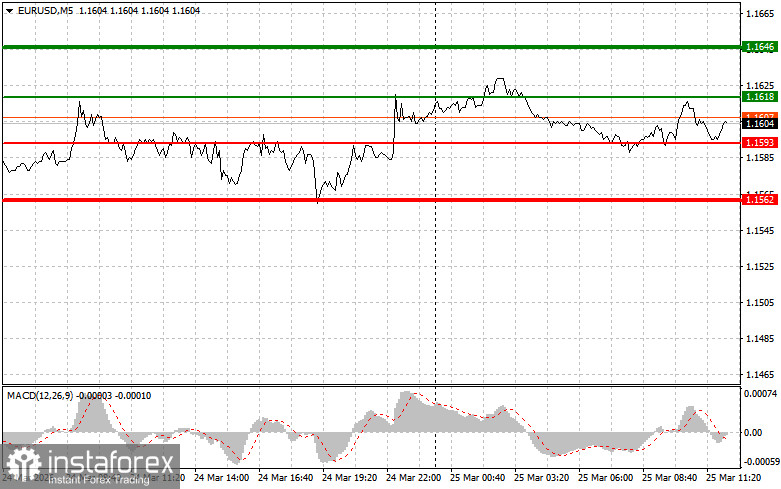
Scenario No. 1: Today, buying the euro is possible when the price reaches around 1.1618 (green line on the chart), with a target of 1.1646. At 1.1646, I plan to exit the market and also consider opening short positions in the opposite direction, aiming for a 30–35 point move from the entry point. Expecting euro growth today is reasonable after weak U.S. data.Important: Before buying, make sure that the MACD indicator is above the zero mark and just starting to rise from it.
Scenario No. 2: I also plan to buy the euro today if there are two consecutive tests of the 1.1593 level while the MACD indicator is in the oversold zone. This will limit the pair's downward potential and lead to a reversal upward. Growth toward the opposite levels of 1.1618 and 1.1646 can be expected.
Sell signal
Scenario No. 1: I plan to sell the euro after it reaches the 1.1593 level (red line on the chart). The target will be 1.1562, where I plan to exit the market and immediately open buy positions in the opposite direction (aiming for a 20–25 point move). Pressure on the pair may return at any moment.Important: Before selling, make sure that the MACD indicator is below the zero mark and just starting to decline from it.
Scenario No. 2: I also plan to sell the euro today if there are two consecutive tests of the 1.1618 level while the MACD indicator is in the overbought zone. This will limit the pair's upward potential and lead to a reversal downward. A decline toward the opposite levels of 1.1593 and 1.1562 can be expected.
Chart notes
- Thin green line – entry price for buying the instrument;
- Thick green line – estimated level for placing Take Profit or locking in profits, as further growth above this level is unlikely;
- Thin red line – entry price for selling the instrument;
- Thick red line – estimated level for placing Take Profit or locking in profits, as further decline below this level is unlikely;
- MACD indicator: when entering the market, it is important to consider overbought and oversold zones.
Important: Beginner Forex traders should be very cautious when making entry decisions. Before major fundamental reports are released, it is best to stay out of the market to avoid sharp price fluctuations. If you choose to trade during news releases, always use stop-loss orders to minimize losses. Without stop-loss orders, you can quickly lose your entire deposit, especially if you do not use proper money management and trade large volumes.
Remember that successful trading requires a clear trading plan, like the one outlined above. Making spontaneous trading decisions based on current market conditions is generally a losing strategy for an intraday trader.